
Xeus is now a Jupyter subproject
It is a great pleasure to announce that the Xeus project has been incorporated as a Jupyter subproject. Xeus will now be subject to the Jupyter governance and code of conduct.
For reference, the Jupyter Enhancement Proposal (JEP) for the Xeus incorporation is available here.
What is Xeus?
The Xeus project is a C++ implementation of the Jupyter kernel protocol. Xeus is not a kernel, but a library meant to facilitate the authoring of kernels.
Several Jupyter kernels have been created with Xeus:
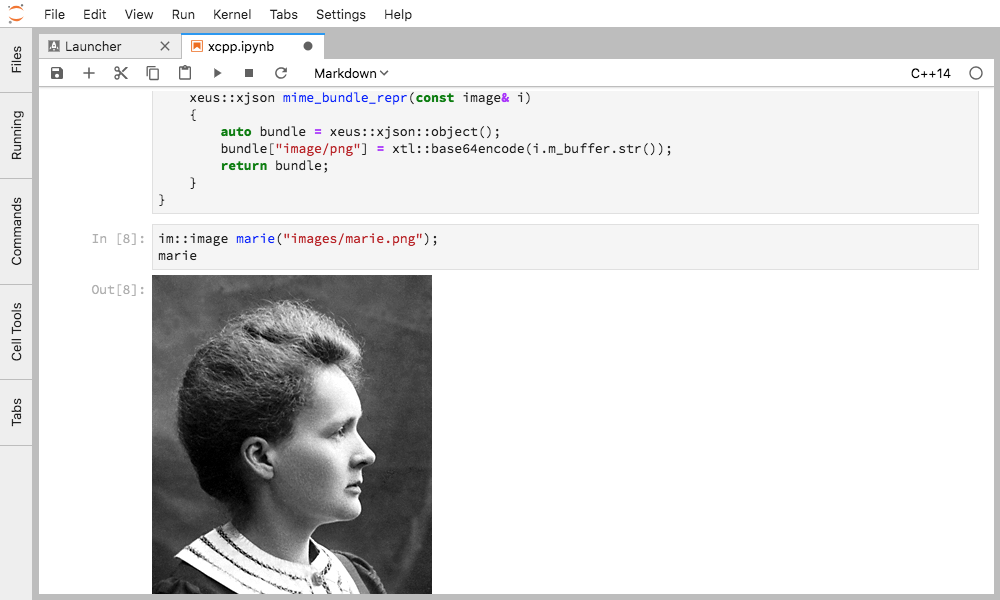
- xeus-cling, a kernel for the C++ programming language, based on the Cling C++ interpreter. The cling project comes from CERN and is at the foundation of the ROOT project.
- xeus-python, a kernel for the Python programming language, embedding the Python interpreter.
- xeus-calc, a calculator kernel, meant as an educational example on how to make Jupyter kernels with Xeus.
Beyond these three kernels built on top of Xeus by the Xeus maintainers, third-parties have developed other Jupyter kernels with Xeus:
- JuniperKernel, a kernel for the R programming language by Spencer Aiello.
- xeus-fift, a kernel for the fift programming language by Michael Zaikin. The fift programming language was developed by Telegram to create TON blockchain contracts.
- SlicerJupyter, a kernel for the Python programming language by Kitware which integrates into the Qt event loop of the Kitware “Slicer” project.
Finally, the xeus-python kernel includes a first implementation of the Jupyter debugger protocol used by the Jupyter debugger project. xeus-python enables the Debug Adapter Protocol over the Control channel through new debug request/reply and debug event messages.
Why moving Xeus under the Jupyter governance?
While Xeus started as a side project for QuantStack engineers, the project now has several stakeholders who depend on it. We think that moving the project to an open governance organization may be a better way to reflect this situation.
Acknowledgements
- Xeus was started by the team of open-source developers at QuantStack as a separate project, but with the full intent to incorporate it into Jupyter. The initial project development at QuantStack was funded by Bloomberg.
- Now, Xeus contributors work in many institutions, including Université Paris-Saclay and École Polytechnique.
About the Author
Johan Mabille is a Scientific Software Developer at QuantStack, specializing in high-performance computing in C++. He holds master’s degree in computer science from Centrale-Supelec.
As an open source developer, Johan coauthored xtensor, xeus, and xsimd. He also made major contributions to the JupyterLab debugger project and bqplot.